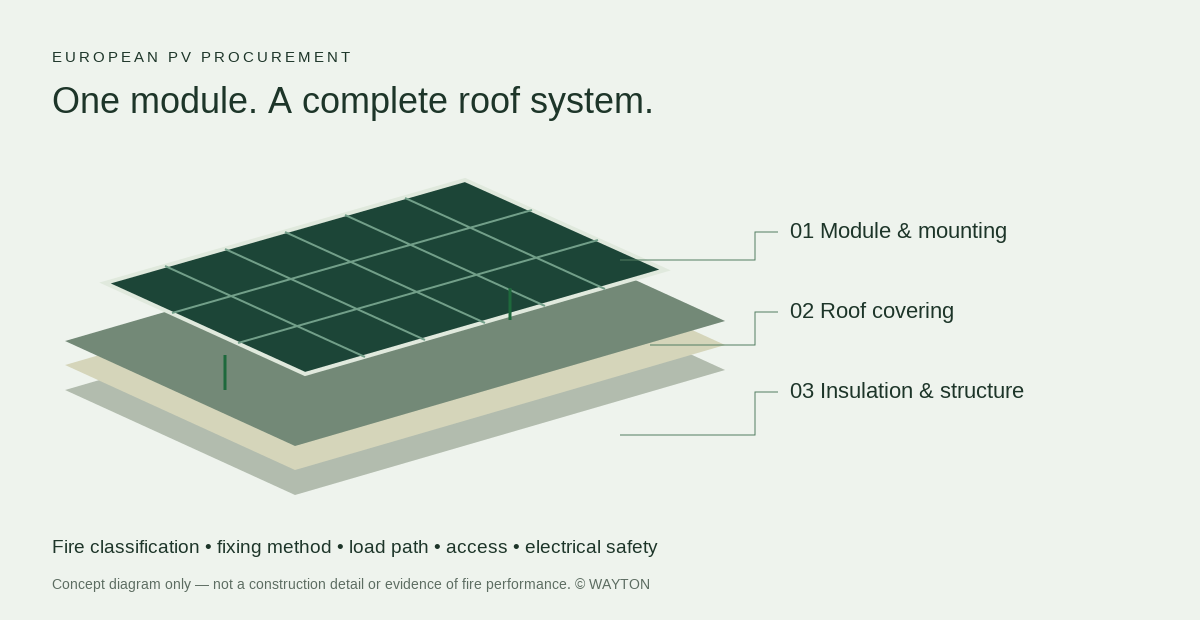
What should a European PV buyer check first?
Start with the country, building and installation method—not a universal “European fire rating”. Match the exact module to its safety evidence, then check the roof assembly, structural design, electrical installation, grid connection and insurer requirements. A good component certificate cannot approve a different roof construction.
For technology, n-type crystalline-silicon modules are the mainstream starting point. Lightweight modules address constrained roofs; bifacial designs need useful rear irradiance; building-integrated PV must perform as part of the building envelope. The best purchase is the documented system that fits the site.
1. Europe is moving toward solar-ready buildings
The EU’s recast Energy Performance of Buildings Directive makes roof planning increasingly relevant to new construction and renovation. Article 10 phases in suitable solar installations, subject to technical suitability and economic and functional feasibility. The timetable below is an EU implementation framework, not a blanket statement that every roof must carry PV. European Commission ↗
| EU deadline | Building category |
|---|---|
| 31 December 2026 | New public and non-residential buildings with useful floor area above 250 m². |
| 31 December 2027 | Existing public buildings above 2,000 m²; existing non-residential buildings above 500 m² undergoing specified major renovation or permitted works. |
| 31 December 2028 | Existing public buildings above 750 m². |
| 31 December 2029 | New residential buildings and new roofed car parks physically adjacent to buildings. |
| 31 December 2030 | Existing public buildings above 250 m². |
The Commission also describes solar-ready design for new buildings whose permit applications are made after 29 May 2026. For an actual tender, verify the national rule, permit trigger, usable floor-area definition and exemptions. The UK and Switzerland are outside this EU framework. European Commission ↗
On 15 July 2026 the Commission announced proceedings concerning incomplete EPBD transposition in all 27 Member States. This is a dated implementation warning, not a claim that all countries remain in the same position today. Confirm the current local implementing provisions before specifying a deadline in a contract. European Commission ↗
2. Four different things can be called a “fire rating”
| Evidence | What it addresses | What the buyer should request |
|---|---|---|
| IEC 61730 safety qualification | Safety of the PV module; construction and testing address defined risks. | Exact model, certificate scope and applicable report. Do not translate a module fire-test label into roof approval. |
| EN 13501-1 reaction to fire | How a classified construction product contributes to fire under the applicable assessment. | Full class and report, including relevant smoke/droplet suffixes and end-use conditions. |
| EN 13501-5 roof classification | External-fire performance of a roof/roof-covering arrangement. BROOF(t1), (t2), (t3) and (t4) identify different test routes. | Classification report and field of application for the actual build-up and installation. The t-numbers are not a quality ladder. |
| Fire resistance, e.g. EI / REI | Integrity, insulation and, where relevant, load-bearing performance for a stated duration. | The assessed element and duration. This is a different question from reaction to fire or external roof fire. |
The distinctions between roof covering and structural fire performance are explained in the UK government’s PV fire research. IEC separately defines module safety qualification. A marketing label such as “Class A fire rated” needs its standard and test scope before it can be compared. UK government ↗ IEC ↗
Practical tender question: “Does the submitted evidence cover this module, roof membrane, insulation, substrate, fixing method, air gap and roof pitch?” If a supplier changes one of those items, ask the designer whether the classification’s permitted scope still covers it. Glass-glass construction alone does not answer that question.
3. Regional comparison: requirements and buying priorities
The left-hand evidence column describes a specific jurisdiction or source. The buying priorities are WAYTON’s engineering-led recommendations for the stated conditions—not surveyed national preferences or a claim that one module type dominates an entire country. This is a screening guide to selected markets, not a legal register of every European jurisdiction.
| Market | Local requirement or evidence | Procurement implication |
|---|---|---|
| Germany | State building rules and the installation’s structural/fire evidence matter. Official guidance distinguishes module and mounting assessments. New building-authority guidance was publicised in September 2026. Regierungspräsidium Tübingen ↗ Brandenburg Chamber of Engineers ↗ | For commercial roofs, compare installed load and the complete fire strategy before price per watt. Ask which state rules and approval route the designer is using. |
| Austria & Switzerland | Austria: check the applicable provincial implementation and local OIB guidance; Vienna publishes its interpretations. Switzerland: cantonal/VKF fire rules and hail exposure require separate review. City of Vienna ↗ Swissolar ↗ | For Alpine sites, prioritise project snow/wind loads, hail evidence, mounting details and replacement access. Do not apply a German approval automatically across borders. |
| France | Article 32 of the cited ICPE order addresses specified authorised installations and roofs over fire-risk zones; it requires at least BROOF(t3) for the described complete assembly. It is not a universal rule for every French home. Légifrance ↗ | Identify the building’s regulatory category first. For the covered industrial situation, obtain assembly evidence including associated supports and insulation, not only a module report. |
| Italy | The September 2025 fire-service guideline updates the 2012 guidance for PV in or serving activities subject to fire-prevention controls. Section 4.2 provides several design routes. Vigili del Fuoco ↗ | Use the fire designer’s selected route for the actual roof. Ask for current documentation and access/isolation arrangements before choosing a module solely on its reaction-to-fire label. |
| Netherlands & Belgium | Dutch RVO stresses installation quality, insurance agreed before installation and SCIOS Scope 12 inspection. Belgium has its own electrical inspection framework under RGIE/AREI. RVO ↗ Belgian Federal Public Service Employment ↗ | For industrial roofs, settle roof capacity, insurance conditions and inspection scope early. Scope 12 is a Dutch inspection scheme; it is not an EU-wide product certificate. |
| Spain & Portugal | Spain’s IDAE provides self-consumption procedures; Portugal’s DGEG administers its own self-consumption registration/licensing routes. IDAE ↗ DGEG ↗ | For hot or dusty sites, compare temperature coefficient, ventilation and a realistic cleaning/water plan. Model self-consumption and export separately. Ground-mounted projects may justify a bifacial study. |
| Sweden / Nordic reference | Sweden’s electrical safety authority asks owners to check roof bearing capacity and snow/wind calculations. Requirements in Denmark, Finland and Norway must be checked individually. Swedish Electrical Safety Authority ↗ | For cold and snow-exposed locations, check string voltage at design minimum temperature, approved clamp zones and load direction. Bifacial gain from snow requires a site model; it is not guaranteed. |
| Poland / Central European reference | Polish government guidance requires fire-safety expert agreement for PV designs with installed electrical capacity above 6.5 kW. This threshold should not be exported to neighbouring countries. Polish government ↗ | Include the local fire review in the programme; compare the installation design and responsible parties along with product documents. |
| United Kingdom — England reference | Approved Document B is guidance for England; roof classifications use the applicable UK test route, including BROOF(t4). Scotland, Wales and Northern Ireland have separate building-rule contexts. UK government ↗ UK government ↗ | Ask the designer for the building-control route and roof evidence for the proposed system. A French t3 report does not, by its label alone, establish t4 compliance. |
The 2025 guideline includes non-combustible support/roof solutions, a specified protective separation option, a module-and-roof classification route and a project fire-risk assessment route. The classification route identifies BROOF(t3/t4) roof coverings alongside specified module evidence. It would therefore be misleading to say “every Italian PV module must simply be BROOF(t4)”. Let the qualified designer document the applicable route. Vigili del Fuoco ↗
4. Which PV module types are most popular—and which fit?
Fraunhofer ISE’s 14 July 2026 report says silicon wafer-based technology represented about 98% of worldwide PV production in 2025, with an 86% n-type wafer share, and identifies monocrystalline n-type TOPCon as dominant. These are global production indicators; they are not European country-by-country retail sales figures. Fraunhofer ISE ↗
Our practical starting point for a conventional new project is to compare current n-type rigid modules, then decide whether other attributes improve the actual project. We have not found a consistent, comparable public dataset ranking module types across all the countries above; there is no defensible “Europe’s favourite panel” league table here.
| Selection layer | Options | How to compare |
|---|---|---|
| Cell technology | TOPCon, heterojunction (HJT), back-contact (BC), legacy PERC | Compare the exact datasheet: efficiency, power temperature coefficient, degradation terms, dimensions and delivered price. A technology name is not a performance guarantee. |
| Light collection | Monofacial or bifacial | Rear-side yield depends on rear irradiance, shading, ground/roof reflectance and mounting geometry. Do not add a blanket bifacial percentage to every roof. IEA PVPS ↗ |
| Construction | Glass-glass, glass-backsheet, lightweight/flexible | Check mass, mechanical limits, moisture protection, approved mounting, fire evidence and repairability for the exact model. |
| Building role | Building-applied PV (BAPV) or building-integrated PV (BIPV) | BAPV sits on the building; BIPV also performs a building-envelope function. Weatherproofing, construction evidence and replacement responsibilities therefore differ. |
What each shortlist option is good for
| Option | Reason to consider it | What can outweigh the attraction |
|---|---|---|
| N-type TOPCon | A sensible mainstream benchmark when comparing new crystalline-silicon modules, given the production trend cited above. | The particular module’s dimensions, current, load rating, warranty, evidence and installed cost still decide suitability. |
| Heterojunction (HJT) | Include it when the offered datasheet provides a useful efficiency or temperature-coefficient advantage for the site. | Quantify the benefit in a yield model against price and system constraints; do not assume every HJT product beats every TOPCon product. |
| Back-contact (BC) | A candidate where the offered model’s efficiency or appearance helps a space-constrained or visible roof. | Review the exact shading behaviour, appearance, availability and replacement route. BC is a family of designs, not one performance level. |
| Legacy PERC | May remain relevant when comparing an existing installation’s replacement options or a specific commercial offer. | Do not treat a lower module price as lower lifetime cost. Check degradation terms, efficiency and future matching stock. |
| Bifacial construction | Worth modelling on open structures or ground mounts where rear light can reach the module. | A close-mounted opaque roof may provide little useful rear irradiance. Structure and shading can erase an assumed gain. |
| Lightweight / flexible | Can create an option where panel mass, roof shape or mounting constraints make conventional designs difficult. | Demand model-specific fire, fixing and environmental evidence, plus a credible removal and replacement method. |
If two candidate modules have power-temperature coefficients of −0.29%/°C and −0.35%/°C, at a cell temperature 35°C above the 25°C reference their simplified temperature-related power reductions are 10.15% and 12.25%. That is a 2.1 percentage-point difference relative to reference power—not an annual energy gain. These assumed values do not describe a WAYTON model or rank cell technologies.
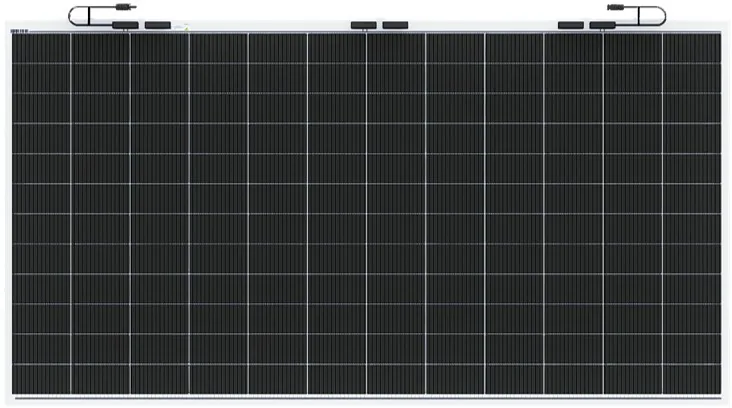
Start with the roof constraint.
For a load-constrained roof, assess lightweight and flexible PV options against installed mass, attachment and roof-warranty conditions. For an unconstrained conventional roof, compare rigid modules on installed cost and modelled yield. Product imagery is illustrative; specific certificates and ratings follow the offered model.
5. Select for the use case, then compare lifetime value
| Project | Useful shortlist | Decision that can change the answer |
|---|---|---|
| Space-constrained commercial roof | High-efficiency rigid modules, including current n-type options | Usable area after access/setbacks; inverter current limits; installed €/kWp rather than panel price alone. |
| Roof with limited spare capacity | Documented lightweight solution versus a structurally acceptable rigid design | Complete system load, wind uplift, adhesive/substrate approval, fire route and roof life. |
| Ground mount or open carport | Bifacial options where rear light is available | Site yield model, row spacing, shading, structure and cable/inverter ratings. |
| Architectural roof or façade | Purpose-designed BIPV system | Building-envelope approvals, water management, appearance and replacement method. |
Assume 1,000 m² of usable module area after all exclusions. At the standard test irradiance of 1,000 W/m², 21% module efficiency corresponds to about 210 kWp; 23% corresponds to 230 kWp. That is 20 kWp more nominal DC capacity, not automatically 9.5% more annual AC energy. Check layout, shading, inverter clipping, temperature and grid/export limits before pricing the benefit.
A higher nameplate wattage can simply reflect a larger module. Compare W/m², kg/m², installed loading and handling constraints. For hot sites, compare the actual power-temperature coefficients; for cold sites, verify open-circuit string voltage at the design minimum temperature. For coastal or agricultural sites, ask whether environmental test evidence covers the intended exposure.
6. What should be in the European PV purchase file?
Request a model-specific evidence pack before freezing the order. IEC 61215 addresses design qualification/type approval; IEC 61730 addresses safety. Neither alone approves the entire installation. IEC ↗ IEC ↗
Product evidence
Exact manufacturer and model; current datasheet; serial traceability; applicable conformity declarations; relevant certificates and report scope; installation and maintenance manuals; warranty terms.
Project evidence
Roof survey and structural assessment; fire strategy and assembly evidence; mounting layout; electrical design and grid requirements; inspection/commissioning plan; named maintenance and warranty contacts.
For a WAYTON enquiry, send the country/postcode, building use, roof build-up and drawings, available roof load, target capacity, grid arrangement and insurance conditions. We can coordinate equipment selection and the documentation requested for the proposed supply scope. Local design, approvals and on-site service responsibilities should be assigned in the project agreement.
Continue with PV maintenance, cleaning and after-sales and our lightweight roof selection guide.
Frequently asked questions
Is there one mandatory PV fire class for all of Europe?
No. The applicable requirement depends on country, building category, installation and the object being classified. Module safety, reaction to fire, external roof fire and fire resistance are different assessments.
Are TOPCon, bifacial and glass-glass competing module types?
Not necessarily. TOPCon describes cell technology, bifacial describes light collection on both sides, and glass-glass describes construction. One module can have all three attributes.
Does a lightweight PV module automatically make a roof suitable?
No. The installed load, wind uplift, attachment, roof condition, fire evidence and waterproofing interfaces still require assessment.
Sources, scope and review date
Sources checked 22 October 2026. Regulatory scope and effective dates matter: confirm the applicable national and local position for the actual project. Comparisons and numerical examples are WAYTON editorial analysis; they are not supplier test reports or customer project results.
- European Commission — solar energy in buildings, EPBD Article 10
- European Commission — EPBD transposition notice, 15 July 2026
- IEC — IEC 61215-1:2021, design qualification and type approval
- IEC — IEC 61730-1:2023, module safety construction requirements
- UK government — Fire safety: solar photovoltaic panels, research report, §4
- Vigili del Fuoco — coordinated Note 14030, 1 September 2025, §§1.2 and 4.2
- Légifrance — Order of 4 October 2010, Article 32, version in force since 4 April 2022
- Regierungspräsidium Tübingen — PV construction approval and structural evidence
- Brandenburg Chamber of Engineers — May 2026 building-authority PV guidance, notice 4 September 2026
- City of Vienna — fire-safety guidance and OIB interpretations
- Swissolar — protection from damage, cantonal/VKF rules and hail
- RVO — PV safety and insurance, checked 4 March 2026
- Belgian Federal Public Service Employment — electrical installations and RGIE
- IDAE — professional guide to self-consumption procedures
- DGEG — self-consumption and renewable energy communities
- Swedish Electrical Safety Authority — planning a solar installation
- Polish government — fire-safety review of PV designs above 6.5 kW
- UK government — Approved Document B, England, updated 16 September 2026
- Fraunhofer ISE — Photovoltaics Report, 14 July 2026, pp. 5 and 34
- IEA PVPS — Bifacial Photovoltaic Modules and Systems, 2021
Diagrams and comparison layouts: original WAYTON editorial graphics. The product photograph is from the existing WAYTON catalogue. External sources are linked for attribution; their charts and photographs have not been reproduced.