What protects the lifetime value of a PV system?
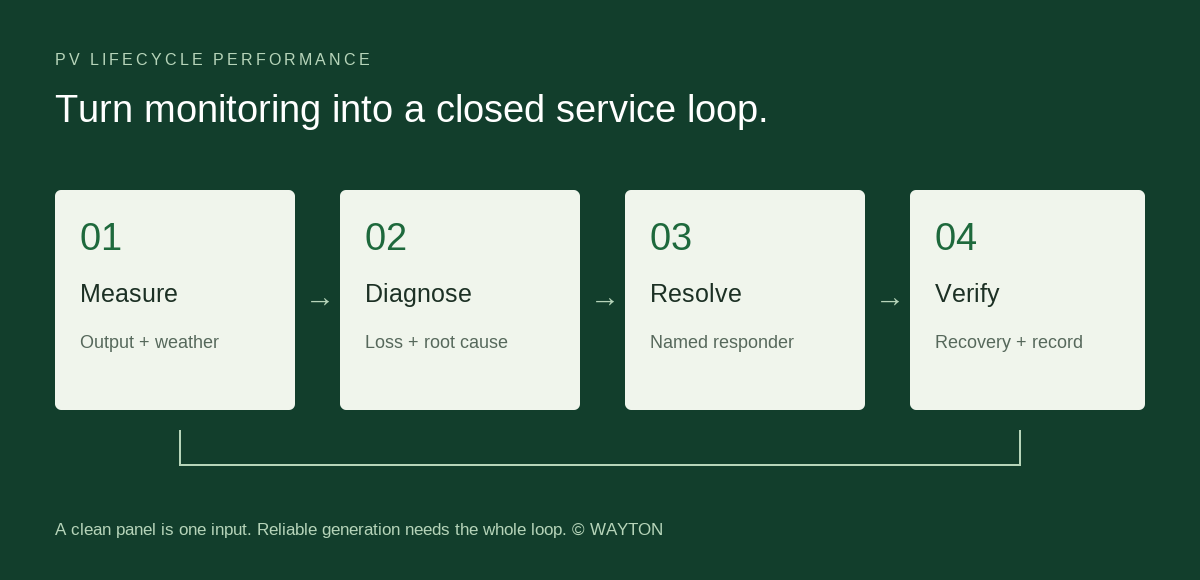
Monitor performance, investigate losses, maintain safely and close the service loop. Cleaning is one task within that process. A module warranty does not replace fault detection, safe roof access, inverter support or a named contractor who can resolve an outage.
The right plan follows the site, the equipment manuals and the consequences of failure. It defines who receives alarms, who attends, which costs are covered, and how recovery is verified.
1. Diagnose the loss before buying a cleaning visit
A fall in monthly kWh can come from weather, shading, soiling, an inverter outage, export limitation, a failed meter or a communication problem. Cleaning will not fix all of these. Begin with the expected generation for the actual weather and operating conditions; then compare affected and healthy parts of the installation.
| Observed pattern | Possible explanation—not a remote diagnosis | First evidence to collect |
|---|---|---|
| Whole site suddenly reports zero | Grid/inverter outage, shutdown, meter or communications failure | Independent meter status, inverter alarms, grid event and communications logs. |
| One inverter or string falls behind peers | Local shading, equipment fault, connection problem or uneven soiling | Comparable string/inverter trends, layout and a qualified inspection. |
| Gradual weather-adjusted decline | Soiling, new shading, degradation or sensor error | Irradiance and temperature records, site changes and a controlled comparison. |
| Midday output repeatedly plateaus | Inverter clipping, export control or curtailment | Power limits, control setpoints and export/dispatch records. |
| Visible damage, burning smell or safety alarms | A potentially unsafe condition | Activate the agreed safety response; keep people away and use qualified responders. Do not treat this as routine cleaning. |
PNNL’s O&M guidance describes system inspection and monitoring; NREL’s third-edition best-practice report provides a broader framework for preventive and corrective maintenance. The table above is an editorial triage tool, not a fault diagnosis. Pacific Northwest National Laboratory ↗ NREL ↗
2. How often should solar panels be cleaned?
There is no single cleaning interval that is right for every European PV installation. Dust, pollen, birds, nearby works, roof pitch, rain and water quality all affect the decision. Follow any model-specific maintenance obligations and inspect after relevant events. Use measured losses to optimise additional cleaning.
IEA PVPS estimates that soiling causes roughly 3–5% of annual PV energy losses globally. This is a worldwide estimate, not a forecast for a particular European roof. Its September 2025 fact sheet emphasises measurement and site-specific mitigation. IEA PVPS ↗ IEA PVPS ↗
Wet does not mean clean.
Rain may remove loose deposits but leave persistent bird fouling or dirt at lower module edges. Check what remains and whether it creates local shading; do not decide solely from rainfall totals.
Dusty does not prove the payback.
A photograph cannot quantify recoverable energy. Use a suitable soiling measurement or a controlled clean-versus-soiled comparison, with weather and shading accounted for.
For dry southern sites, plan water access and a permitted disposal method at design stage. For agricultural sites, consider seasonal deposits. For snow-exposed roofs, agree a safe snow strategy with the designer; a wish to regain generation is not a reason to send untrained staff onto an icy roof.
3. When does a cleaning visit pay for itself?
Use the energy that cleaning is likely to recover over a defined future window—not the entire plant’s annual revenue. The simple screening calculation is:
Expected clean-system generation in the decision window × recoverable soiling loss × value of recovered electricity = estimated gross energy benefit. Subtract the complete cleaning cost. If exported and self-consumed electricity have different values, calculate each portion separately.
Assume the system would produce 100 MWh in the chosen window if clean, cleaning would recover 3%, and that energy is worth €0.12/kWh. Recovered value is 100,000 × 0.03 × 0.12 = €360. A €450 visit leaves −€90 on energy value alone. At those assumptions, the break-even recoverable loss is 450 ÷ (100,000 × 0.12) = 3.75%.
This calculation assumes the loss would persist over the window and cleaning restores it. Expected rain, re-soiling, curtailment, downtime during cleaning and measurement uncertainty can change the result. Include access equipment, labour, water, supervision and any business interruption in the cost. Safety defects, damaging local fouling and mandatory maintenance require their own response; they are not deferred just because an energy-only calculation is negative.
This measured approach is consistent with IEA PVPS guidance to optimise cleaning around site conditions rather than relying only on a fixed calendar. IEA PVPS ↗
4. Safe cleaning starts with the exact module manual
The method must suit the actual module surface, coating, frame, mounting and roof. Ask the contractor to document the approved equipment, water quality, temperature limits and cleaning chemicals. Instructions for one manufacturer or model must not be copied onto a different product.
For example, LONGi’s V3 maintenance manual addresses water quality and temperature, suitable tools, damaged modules and post-cleaning inspection. It forbids standing or walking on modules and warns against cleaning broken glass or exposed cables. Those are manufacturer instructions for the covered products, not a universal WAYTON cleaning specification. LONGi ↗
| Before the visit | During the work | Before closing the job |
|---|---|---|
| Confirm manual revision, method statement, roof-access arrangements and competent personnel. | Follow the approved method; prevent scratching, thermal shock and damage to seals, wiring or the roof. | Record areas cleaned, method, water conditions, date and before/after observations. |
| Check weather, fragile roof areas, existing defects and the site electrical safety procedure. | Keep connectors and electrical equipment protected; stop if damage or an unsafe condition is discovered. | Inspect for damage and verify performance under comparable conditions. |
Illuminated PV modules can generate DC voltage even if the AC supply is switched off. Isolation and access procedures must be established by competent personnel. Owners should not unplug connectors, walk on modules or attempt live electrical work as part of cleaning. LONGi ↗
5. Build an O&M plan around events and responsibility
The following is a proposed framework for a commercial owner to agree with the installer and service provider. Actual frequencies come from risk, local rules, insurance, equipment manuals and contract terms. Remote monitoring should support—not replace—physical inspection.
| Trigger or activity | What the plan should deliver | Named owner |
|---|---|---|
| Commissioning / handover | As-built drawings, serial list, test results, settings, manuals, warranties, portal access and baseline performance. | Installer/EPC supplies; owner verifies receipt. |
| Routine monitoring | Alarm routing, meter/inverter data quality, expected-versus-actual output and unresolved-ticket review. | Owner or appointed monitoring/O&M provider. |
| Planned inspection | Condition of modules, mounting, roof interfaces, drainage, cables, protection and equipment; qualified testing where specified. | Competent local service provider. |
| After storm, hail, roof work or major alarm | Risk-led inspection and a decision on safe operation; record the event and affected equipment. | Site responsible person plus qualified contractor. |
| After repair or cleaning | Confirm settings and normal operation, compare weather-adjusted performance and close the evidence record. | Service provider reports; owner accepts. |
| Annual contract review | Assess downtime, repeated faults, exclusions, spare parts, response performance and next-year priorities. | Owner and service partner. |
6. Why after-sales matters as much as a long warranty
A long warranty term is useful only when the owner can identify the responsible party, prove the problem and obtain a practical remedy. The module manufacturer, inverter supplier, installer, roof contractor and O&M provider may have different obligations. Write down the interfaces before purchase.
| Commitment | What to clarify | Common gap to close |
|---|---|---|
| Module product warranty | Covered defects, exclusions, claim evidence and available remedy. | Who pays diagnosis, removal, shipping, reinstallation and access equipment? |
| Module performance guarantee | Guaranteed power curve, test conditions and assessment process. | A module power guarantee is not an annual system-energy guarantee. |
| Inverter / monitoring support | Hardware coverage, remote access, firmware support and replacement route. | A module warranty does not resolve an inverter outage or lost monitoring data. |
| Installation / roof workmanship | Electrical installation, fixings, penetrations, waterproofing and labour responsibility. | Different contractors may each exclude the other’s interface. |
| O&M service agreement | Alarm hours, acknowledgement, remote triage, attendance, restoration targets and exclusions. | A promised response time may mean an email—not a repaired plant. |
If an affected system section would have generated 600 kWh/day, ten days of avoidable outage at €0.12/kWh represents €720 of lost energy value. This ignores weather variation, repair costs and any contractual compensation. It illustrates why local attendance and compatible spares can matter even when a replacement part is free.
Ask whether replacements must match string current, voltage, dimensions, connector system and mounting constraints. A newer module with more watts is not automatically a compatible substitute. Where the original model is discontinued, require the proposed replacement and design change to be reviewed.
7. Keep a claim file that can be acted on
The fastest useful support request is specific. Include the site and installation date, model and serial numbers, invoice, commissioning records, a location-labelled photograph, alarm history, time-stamped production data and a description of what changed. Keep maintenance and cleaning records with the same file. Share only the access credentials and personal data actually required through an agreed secure channel.
Agree who approves investigation costs before dispatch, whether testing is required, who authorises removal, and when a service ticket escalates. Maintain an export of monitoring data so the plant history does not depend solely on one installer account. This is an owner’s evidence-management recommendation; the actual warranty determines the claim requirements.
A useful monthly review shows availability, weather-adjusted output, estimated recoverable losses, open faults by age, actions taken and verified recovery. Define the availability denominator and exclusions: a 99% figure is ambiguous without knowing whether it counts night hours, curtailment or communications outages.
8. Put lifecycle support in the procurement brief
Specify the service scope with the equipment.
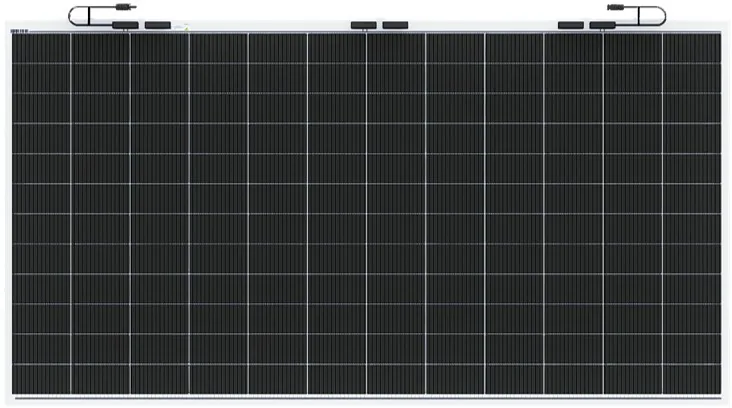
When discussing PV modules with WAYTON, include the project country, roof and access conditions, operating objective, desired service responsibilities and warranty expectations. We can coordinate the proposed supply documentation and support interfaces; local attendance, response times and included costs must be agreed for the order.
For a roof that will need replacement before the PV system’s planned life ends, price removal and reinstallation now. For a lightweight bonded installation, ask how a failed module can be removed without unacceptable roof damage. Good maintenance starts with a maintainable design, a clear handover and a reachable service chain.
Read the companion European PV requirements and module-selection guide, or send your project brief to discuss the equipment and documentation scope.
Frequently asked questions
Does rain remove the need to clean solar panels?
Not always. Rain can remove loose dirt while leaving persistent deposits or edge fouling. Follow the module manual and assess actual conditions and measured losses.
Does switching off the inverter make PV modules safe to wash?
No. Illuminated modules can still generate DC voltage. The service contractor must establish a safe method and access arrangements for the actual installation.
Is a module performance warranty an energy-yield guarantee?
No. It normally concerns module power under specified assessment conditions. Whole-system energy depends on weather, design, availability, controls, shading and maintenance; read the actual warranty.
How should a cleaning decision be made?
Meet safety and required maintenance obligations first. For additional yield-driven cleaning, compare recoverable energy value over a defined window with the full cleaning cost, using measured soiling and realistic assumptions.
Sources, scope and review date
Sources checked 22 October 2026. Regulatory scope and effective dates matter: confirm the applicable national and local position for the actual project. Comparisons and numerical examples are WAYTON editorial analysis; they are not supplier test reports or customer project results.
- IEA PVPS — Soiling Losses: Impact on the Performance of PV Power Plants, 2022
- IEA PVPS — understanding, measuring and mitigating soiling, September 2025
- Pacific Northwest National Laboratory — solar photovoltaic O&M guidance
- NREL — Best Practices for PV and Energy Storage O&M, third edition, 2018
- LONGi — PV Module Maintenance Manual, V3.0, §§1–3; manufacturer-specific example
Diagrams and comparison layouts: original WAYTON editorial graphics. The product photograph is from the existing WAYTON catalogue. External sources are linked for attribution; their charts and photographs have not been reproduced.