What makes a charger suitable for a Kenyan project?
Match the confirmed supply, measured power quality, vehicle interfaces and operating model. Specify behaviour during voltage variation, phase faults, communications loss and recovery—not just rated kW. Mandatory approvals, documented local configurations and project recommendations are different evidence categories.
1. Start with the Kenyan supply and the actual feeder
EPRA tariff material identifies 240 V single-phase / 415 V three-phase connections; the Distribution Grid Code sets nominal frequency at 50 Hz. Confirm the site voltage, phase arrangement and earthing with the utility and installer.
Supply standards are not charger operating limits
EPRA reliability reporting records interruptions at system level. It does not establish one feeder’s voltage quality. Measure voltage events, outages and peak demand before buying against a generic “Africa specification”. [2]
2. Which configurations have public local evidence?
| Configuration | Evidence | Buying implication |
|---|---|---|
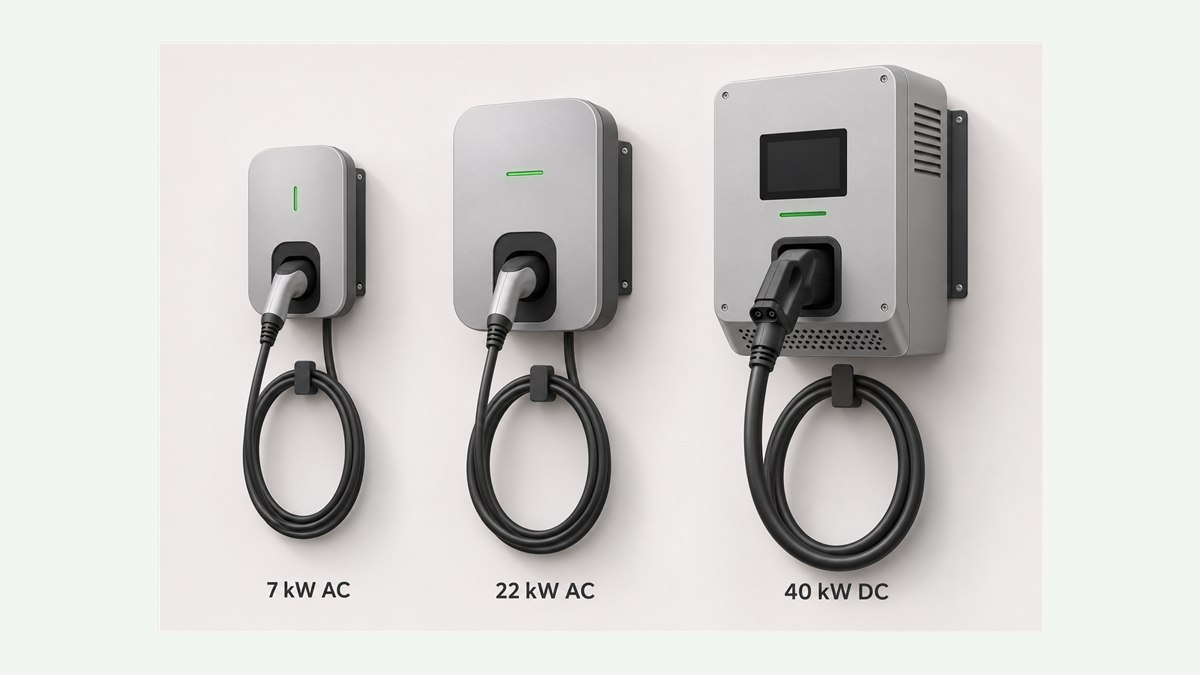
| 7 kW-class / 22 kW AC wallboxes | A Kenyan supplier lists 7.4 / 22 kW AC models | Assess residential/destination needs, vehicle AC limits and phase capacity |
| 22 kW AC + 50 kW DC | Kenya Power documented this pairing at Stima Plaza in 2024 | Both have local deployment evidence; one site does not establish dominance |
| Compact 30–40 kW wall-mounted DC | A candidate project format; prevalence not established by these sources | Verify vehicle voltage range, supply capacity, cooling and service |
| Higher-power public / fleet DC | A separate application needing a connection and duty assessment | Do not exclude it merely because wallboxes fit another segment |
EPRA’s 2023 table lists Type 2 AC and CCS/CHAdeMO DC categories. It does not establish connector market shares. List the target vehicles and their exact inlets/protocols before fixing cable options. [3–5]
3. Turn site conditions into a technical schedule
| Risk to assess | Required evidence / behaviour |
|---|---|
| Voltage dips, rises and recovery | Input window, full-power/derated regions, trip thresholds, hysteresis and recovery; not just “wide input” |
| Surges, phase faults and earthing | Coordinated surge/residual-current protection, phase-loss/unbalance response and site earthing |
| Limited spare capacity | Adjustable current, load management, per-phase limits and safe control-meter failure fallback |
| Power interruption | Logs, transaction retention, fault checks and controlled restart; no outage charging without a designed energy source |
| Data loss | Offline authorisation policy, buffered metering/events and reconciliation; OCPP alone is not M-Pesa integration |
| Dust, rain, heat, coast or altitude | Verified environmental ratings, corrosion strategy, cooling and derating; no universal IP65 or cooling rule |
Witness the required modes with the actual backend and installation. Agree diagnostics, replaceable parts, warranty exclusions and local service. These are risk-based procurement recommendations, not additional Kenyan laws. [1,7]
4. An AC wallbox is not a voltage regulator
AC control and DC conversion do different jobs
Protection + control
AC → DC
Off-board conversion
Compatible regulated DC
Where measurements exceed the verified operating envelope, assess the connection and protection first. Any conditioning, generator or storage solution needs its own design and economics.
Optional voltage stabilisation: if assessment confirms the need, WAYTON can supply a voltage stabiliser matched to the measured input range, load, phases and environment. Read the Africa application guide →
5. Separate import, connection and operation permissions
EPRA’s 2023 guidelines distinguish public, non-commercial private and captive charging, call for a public-station retail supply licence, and address conformity, inspection, completion and separate metering. Confirm the actual route; private does not mean unregulated. [5]
Check KEBS/PVoC conformity before shipment and the applicable connection, installation and local approvals before energisation. An equipment report is not station operating permission. Compare the current utility billing conditions and complete delivered scope, not an isolated charger price. [6]
From market context to your project specification.
Share the supply survey, vehicle mix, operating category and environment. WAYTON can compare charger and service options across suppliers and supply voltage-stabilisation equipment where the assessment confirms a need.
Discuss your project · tech@waytonenergy.com ↗Sources & reading notes
8 primary and direct-market sources · reviewed 17 November 2026
- EPRA · Kenya National Distribution Grid Code, March 2024 ↗Connection, power-quality and energy-storage provisions; project applicability and approved settings require confirmation.
- EPRA · Energy & Petroleum Statistics Report, year ended 30 June 2026, table 2.1 ↗Official installed-capacity data; not shipments, module-type shares or a complete small-system inventory.
- Public Kenyan supplier catalogue · AC and DC ranges ↗Listed availability only, not national market shares or endorsement of vendor technical claims.
- Kenya Power · Published 22 kW AC / 50 kW DC station, April 2024 ↗A documented local installation, not a WAYTON project or proof of a national preference.
- EPRA · EV charging and battery swapping guidelines (2023) ↗Dated public/private route and installation guidance; confirm applicability with EPRA.
- KEBS · PVoC Manual v14 ↗Import conformity framework; confirm the current route for the actual product, consignment and origin.
- Open Charge Alliance · Functionality FAQ ↗Backend-dependent capabilities; OCPP alone does not implement payment integration.
- U.S. DOE AFDC · Onboard charger glossary ↗Technology explanation only; no foreign electrical regulations applied to Kenyan sites.
Official statistics, published projects, local product listings and engineering examples are identified separately. Availability is not market share. This review does not establish a national sales ranking or replace project-specific engineering and approvals.