
What should an Italian buyer specify first?
For Italian C&I procurement, WAYTON generally starts with cast-resin dry-type and an aluminium-winding option, reflecting our market experience. Match the MV winding to the DSO connection and the LV winding to the actual site bus or converter. Then select the enclosure, losses and tests for that installation.
- 400, 690 and 800 V are equipment-side choices; 10–30 kV belongs to the MV side.
- Aluminium or copper; open or enclosed—compare the complete configured transformer.
- Size for kVA, not battery kWh. Grid connection approval covers the complete plant.
1. Why start with dry-type for Italian C&I projects?
For many Italian commercial and industrial substations, our procurement starting point is cast-resin dry-type. That is a selection preference based on WAYTON’s market experience, not a rule that excludes other transformer technologies.
Cast-resin dry-type
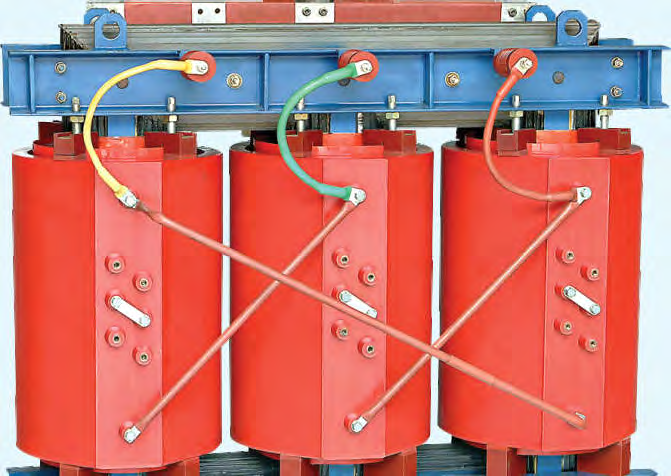
Start here for indoor commercial and industrial substations, especially where avoiding insulating liquid fits the fire and environmental strategy. Specify ventilation, site classes and access protection. A dry-type transformer can also serve PV or BESS if designed for the converter duty.
Liquid-immersed
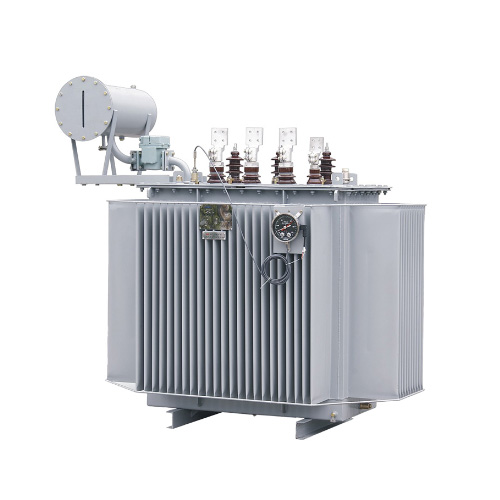
Review liquid-immersed for outdoor central-inverter stations, utility substations or larger-duty packages designed around liquid cooling. It remains a credible candidate where the station layout, losses and lifecycle cost favour it and fluid/fire/containment provisions are acceptable. Neither PV nor BESS automatically requires oil.
The dry-type-first approach reflects WAYTON’s market experience, not a quantified national market share or a mandatory technology rule.
2. 400, 690 or 800 V? Separate the two sides.
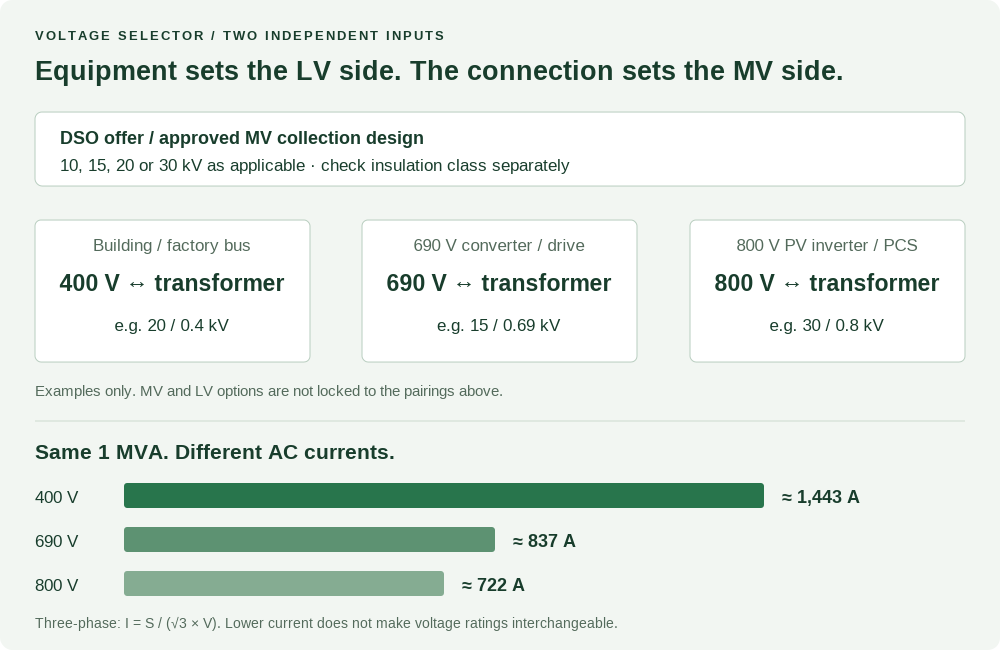
These are not competing grades of transformer. In this guide, 400, 690 and 800 V mean three-phase AC line-to-line voltage on the site/converter side. The MV winding matches the distribution or collection network. Read 20/0.69 kV as 20,000 V on one winding and 690 V on the other—not a 690 V public grid.
Italy has more than one MV voltage. E-Distribuzione identifies 15/20 kV as predominant; its Section E also addresses 30 kV and sub-15 kV networks, including 10 kV. Obtain the actual voltage and any planned network conversion from the DSO. Equipment insulation class Um is a separate rating: 30 kV operation is not the same thing as a 36 kV insulation class. [4, 11]
 Open full-size diagram ↗
| AC equipment side | Typical selection route | Transformer brief |
|---|---|---|
| 400 V | Existing building/factory LV bus; PV or PCS designed for that bus. | Match the existing bus and required neutral. Example: 20/0.4 kV. |
| 690 V | An industrial drive, central inverter or PCS explicitly rated at 690 V. | Dedicated 0.69 kV winding; match the actual MV connection, e.g. 15/0.69 kV. |
| 800 V | A utility PV inverter or PCS explicitly rated at 800 V. | Dedicated 0.8 kV winding; e.g. 30/0.8 kV only if the project MV system is 30 kV. |
At equal kVA, a higher AC voltage reduces current: 1 MVA is about 1,443 A at 400 V, 837 A at 690 V and 722 A at 800 V. This can ease AC cable and busbar requirements, but it is not permission to substitute voltages. Match converter voltage range, insulation, earthing, protection and transformer duty. A 690/800 V circuit cannot directly supply an ordinary 400 V building bus. [12, 13]
Choose the winding and enclosure around the installation
WAYTON commonly starts European inquiries with aluminium windings and offers copper as an optional specification. State the material for both MV and LV windings. Compare guaranteed losses, temperature rise, short-circuit performance, footprint and price; copper alone does not prove a higher efficiency class. [2, 15]
 Open full-size diagram ↗
| Choice | Specify it this way |
|---|---|
| Aluminium / copper | Al/Al as an inquiry starting point; quote Cu/Cu as an option if required. Confirm the offered winding construction and guaranteed performance. |
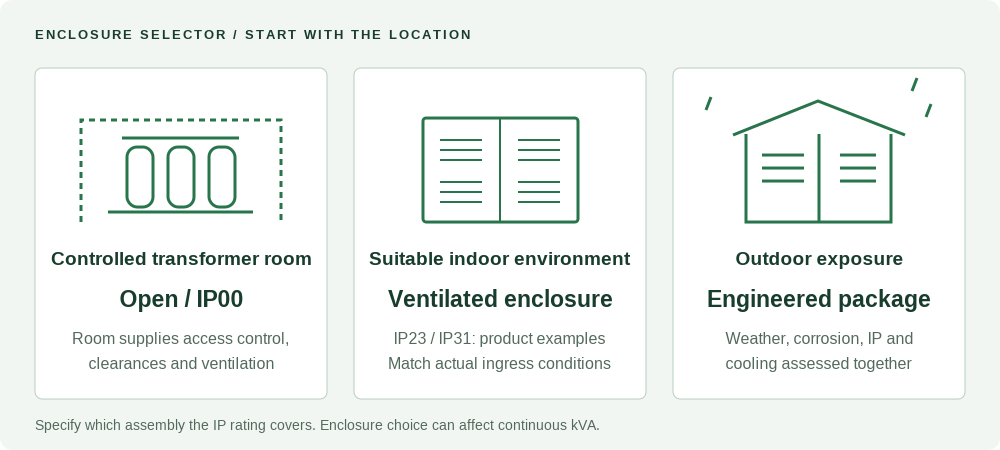
| Open / IP00 | Inside a dedicated, access-controlled transformer room with engineered clearances, barriers and ventilation. IP00 provides no enclosure protection against contact or water. |
| Indoor enclosure | Ventilated IP23 or IP31 are available product examples—not interchangeable environmental ratings. Select to the actual access and water/solid ingress conditions. |
| Outdoor / custom enclosure | Specify rain, dust, salt, condensation, corrosion, cable entry, door/access arrangements and dimensions. Confirm the proposed IP rating and thermal performance together. |
An enclosure can restrict cooling. Confirm the required continuous kVA at the stated ambient with that enclosure fitted; a higher IP number is not automatically the better choice. Custom dimensions, colour and cable entry are also subject to the manufacturer’s design. [3, 14]
3. How do PV and batteries connect?
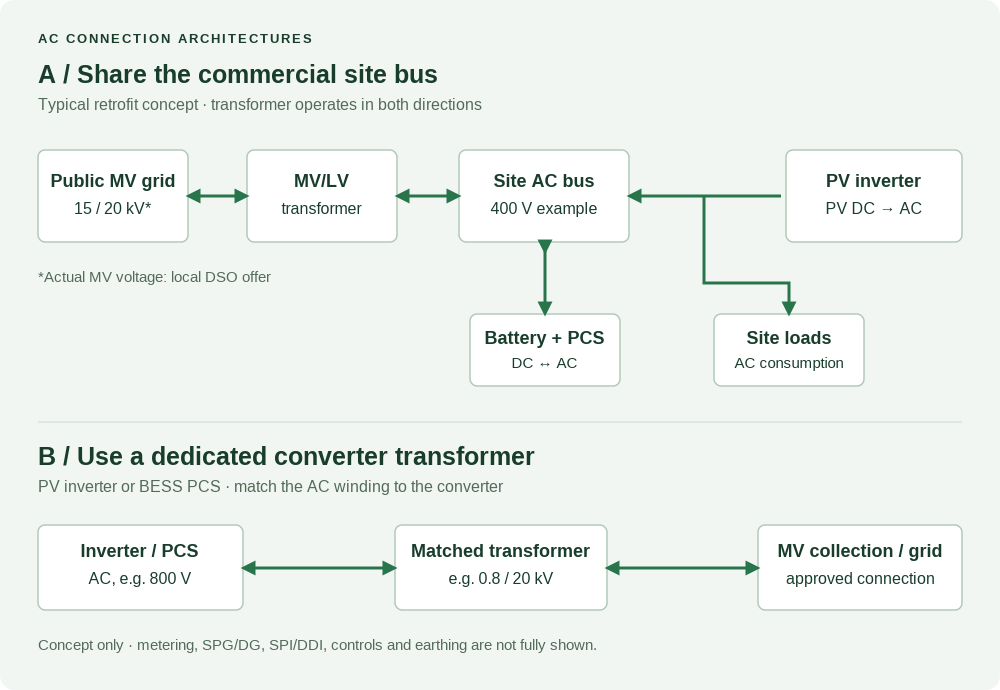
PV modules and batteries deliver DC; an inverter or PCS supplies AC to the transformer. Choose path A for equipment compatible with the commercial site bus. Choose path B for a dedicated converter block: 690 V or 800 V equipment needs a matching winding, even when the rest of the site uses 400 V.
 Open full-size diagram ↗
For an MV point of connection, CEI 0-16 governs the active/passive user connection; CEI 0-21 addresses LV connections. Putting inverters behind an MV/LV transformer does not make the grid connection an LV connection. Confirm the applicable equipment evidence and protection arrangement with the DSO. [5, 6]
Plan the general protection system (SPG/DG), interface protection and disconnection (SPI/DDI), metering and commissioning together. For MV-connected PV/wind plants of at least 100 kW, also check the current CCI plant-controller and PF2 active-power-limitation obligations. Existing/new plant status and capacity affect implementation; do not apply this PV/wind rule indiscriminately to every BESS. [7]
- Obtain the DSO connection offer
- Agree the single-line diagram & protections
- Submit equipment and plant documentation
- Complete tests & the operating agreement
4. Why a 1 MW project may need more than 1 MVA
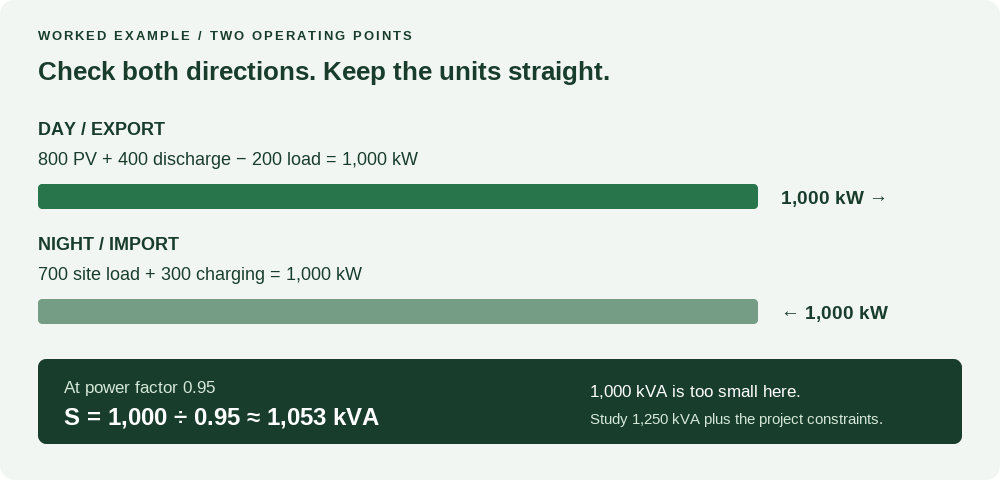
Check the largest credible power flow in either direction, including reactive power. PV module kWp and battery kWh do not determine transformer kVA. For a shared bus, use simultaneous AC power flows and only rely on export/import limits that the design and control system can actually enforce.
 Open full-size diagram ↗
At a power factor of 0.95, 1,000 kW ÷ 0.95 ≈ 1,053 kVA. A 1,000 kVA transformer is already too small for that assumed operating point. A 1,250 kVA unit is a candidate to study—not a final selection—after temperature, harmonics, voltage rise, fault duty and protection checks. A shared grid transformer alone also does not provide backup operation; islanding needs a separately engineered architecture.
5. What efficiency level should you request?
For a new transformer within the regulation’s scope, request EU Ecodesign Tier 2 under Regulation (EU) No 548/2014, as amended by 2019/1783; Tier 2 has applied since 1 July 2021. Applicable limits depend on rating, voltage and construction. [8]
For a conventional two-winding distribution unit, ask for guaranteed no-load loss P₀ and load loss Pk in watts, at the specified reference conditions, against the relevant regulatory table. Larger or other configurations may use a Peak Efficiency Index (PEI) requirement. A bare “high efficiency” claim or loss-class label is not enough.
Sources: [8]
6. Which certificates and documents belong in the order?
Build a document pack around the exact model and serial-numbered unit. Product conformity, factory tests and approval of the complete generating plant are different checks.
| Evidence pack | Ask for |
|---|---|
| Transformer | Agreed IEC/EN 60076 design basis; datasheet, drawings and nameplate; unit routine-test report covering ratio/vector group, losses, impedance and applicable dielectric tests. For dry-type units, include partial-discharge results and evidence for specified environmental/climatic/fire classes. |
| EU conformity | Applicable Declaration of Conformity and CE marking basis, Ecodesign loss guarantees and supporting technical documentation. ISO 9001 describes a quality system; it is not product or grid-connection approval. |
| PV/BESS plant | Model/firmware-specific inverter or PCS conformity evidence, SPI/DDI and CCI evidence where applicable, approved single-line diagram, protection settings/test records, earthing documentation and the DSO operating agreement (regolamento di esercizio). |
Send WAYTON a brief that can become a specification
Send the DSO connection offer, single-line diagram, load/PV/PCS ratings and converter AC voltage. Add indoor/outdoor conditions, winding preference and enclosure requirements. A useful inquiry reads: “1,250 kVA dry-type; 20/0.69 kV; 50 Hz; Al/Al with Cu/Cu option; indoor ventilated enclosure, IP to be agreed; Tier 2; confirm vector group, impedance, taps and continuous rating.” These are illustrative values, not an approved design. WAYTON can help compare configurations and coordinate the supply scope with your design team.
Sources & technical scope
Checked 16 October 2026. This guide covers customer-owned distribution and converter-interface transformers. Final requirements follow the project design, applicable rules and the local DSO’s connection conditions.
Open the 15 technical references
- [2] Sirmet · distribution transformer catalogue
Examples of Italian product formats only; older catalogue loss figures are not a current compliance reference.
- [3] IEC · IEC 60076-11: dry-type transformers
Construction, environmental conditions and test scope.
- [4] E-Distribuzione · the electricity network
Typical distribution-network voltages.
- [5] CEI · official CEI 0-16 / 0-21 standards and updates
Check the current editions, variants and applicable transition provisions.
- [6] E-Distribuzione · grid connection rules
Connection process and technical requirements; other DSOs issue their own connection conditions.
- [7] E-Distribuzione · CCI / PF2 obligations
MV-connected PV/wind requirements under ARERA decisions and subsequent changes.
- [8] EUR-Lex · Regulation (EU) 2019/1783 amending 548/2014
Ecodesign scope, losses, PEI and Tier 2 requirements.
- [9] European Commission · transformer Ecodesign standards
EU conformity framework.
- [10] IEC 60076-1 · test classifications (GSO standards preview)
Routine tests apply to individual units; type tests address representative designs.
- [11] E-Distribuzione · connection guide, Section E
Sections E.3.1–E.3.2 cover other MV voltages and insulation levels. September 2021 edition linked by the DSO’s current rules page; project conditions and current CEI provisions still apply.
- [12] SMA · Sunny Central Storage UP technical data
A documented 690 V battery-converter example; not a claim of Italian approval or WAYTON availability.
- [13] Sungrow · SG350HX technical data
A documented 800 V AC PV-inverter example. The 1,500 V DC input and 800 V AC output are different ratings.
- [14] Legrand · cast-resin transformers and enclosure options
Open construction, IP23/IP31 ventilated enclosures and custom configurations; examples are product-specific.
- [15] Natural Resources Canada · dry-type transformer losses
Technical background on losses in copper/aluminium windings, not a European compliance requirement.
- [16] Hitachi Energy · solar generation transformers
Dry-type and liquid-filled solar transformer options, with project-specific ratings and fluids.