
What should an Italian buyer specify first?
First establish the Italian compliance route: public-grid parallel operation requires the applicable grid-connection evidence; genuinely off-grid installations still require product and site safety compliance. WAYTON offers CEI-certified 233 kWh and 261 kWh outdoor cabinet options. Larger container projects are assessed case by case before finalising the configuration and verification scope.
- Existing PV: assess AC coupling. New PV + storage: compare a hybrid route.
- Calculate energy at the load; nominal kWh is only the starting point.
- Match certification to the exact configuration and the DSO connection requirements.
1. Italy has an entry requirement: establish the compliance route first.
Before selecting battery capacity, establish how the system will be placed on the Italian market and how it will operate at the site. Product conformity, public-grid connection and installation approval are separate checks. A CE mark alone is not permission to connect a storage system in parallel with the public grid.
Applicable CEI compliance is required.
For distribution-connected storage, compliance with the applicable CEI 0-21 or CEI 0-16 connection requirements is a condition of connection, not an optional marketing feature. The connection voltage and approved arrangement determine the route. [5]
Off-grid still has safety requirements.
A system with no public-grid parallel operation is assessed as an isolated installation. Product conformity, electrical safety, battery safety and applicable installation and fire-safety obligations still need to be addressed. [6] [7]
A system operating in parallel with the grid remains a grid-connected arrangement even when controls prevent export. A hybrid system that can operate both connected and islanded must satisfy the requirements of its actual connection and switching arrangement.
What does “CE” mean for a standalone storage product?
CE marking represents the manufacturer's declaration of compliance with applicable EU product legislation; it is not a universal third-party approval certificate. The assessment may include electrical safety and electromagnetic compatibility legislation, as applicable to the equipment, together with the applicable EU Battery Regulation obligations. Request the EU Declaration of Conformity and supporting technical documentation. [6] [7]
The installation must also address protection against electric shock, earthing, isolation, cable protection and the site's fire-safety requirements. Italian fire-service guidance specifically addresses BESS risk analysis and safety measures. Being off-grid does not remove those responsibilities. [8]
CEI 0-21 / 0-16 are discussed here as distribution-connection rules. Transmission-connected projects require the applicable Terna grid-code process. Grid backup or transfer arrangements should be reviewed on their actual single-line diagram.
2. Where should an Italian C&I buyer start?
For a factory, warehouse or commercial site with a repeatable daily energy-shifting requirement, start by assessing a cabinet-based BESS. It gives the engineering team a defined equipment block to compare against site power, space and connection constraints. WAYTON’s current outdoor-cabinet solutions include 233 kWh and 261 kWh options, both with CEI certification. We match the documented configuration to the proposed Italian project.
Our recommendation is to size around a task that happens regularly: store surplus rooftop PV, support a predictable evening load, or reduce a short grid-demand peak. Additional battery capacity is useful when the site can charge it and use the energy.
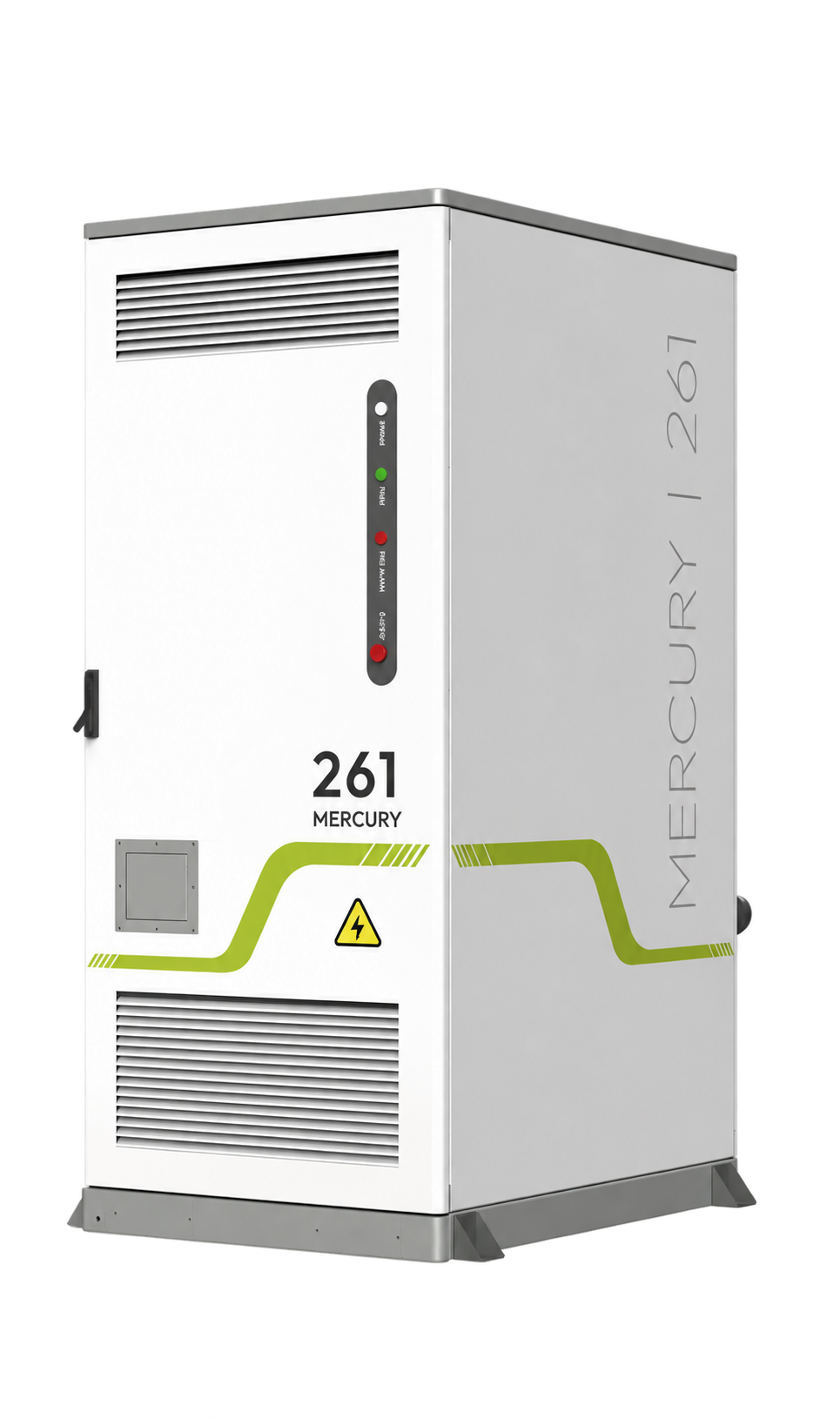
A cabinet sized around your working day.
Assess 233 kWh and 261 kWh against the energy that must be delivered between charging opportunities. Specify converter power separately.
- Existing PV: assess an AC-coupled route.
- New PV + storage: compare a hybrid route.
- Outage support: specify the backup function explicitly.
| Site situation | Selection priority |
|---|---|
| Factory with rooftop PV | Measure midday surplus and the load after solar generation declines. |
| Warehouse or commercial building | Match storage to the actual operating schedule, including weekends. |
| EV charging site | Check coincident charger demand and whether the battery can recharge between peaks. |
| Larger or longer-duration project | Compare an engineered multi-cabinet or container solution; confirm permitted parallel operation. |
3. What does the battery do during the day?
Start with interval load and solar data, ideally covering a representative year. Look at seasonal changes and non-working days as well as the typical weekday. The key quantities are surplus energy available for charging and later demand that can use the stored energy.
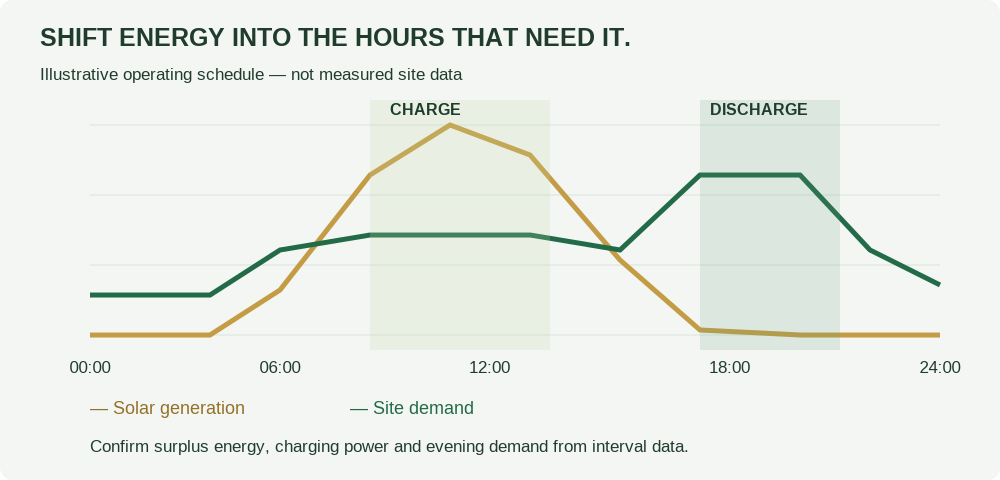 Open full-size diagram ↗
If a site regularly has 250 kWh of midday surplus and needs 180 kWh later, assess a system around that transfer. If surplus is only 70 kWh, a larger cabinet will not create more solar energy; another charging strategy would need its own economic case.
For peak reduction, power and duration matter together. A brief 80 kW peak and an 80 kW demand lasting four hours are very different battery duties. Check that the tariff actually rewards the proposed reduction.
4. 233 or 261 kWh? Calculate what reaches the load.
kW is the delivery rate; kWh is the energy available over time. For a steady 100 kW load over two hours, the AC energy requirement is 200 kWh. Nameplate battery capacity must also accommodate the permitted energy window and conversion losses.
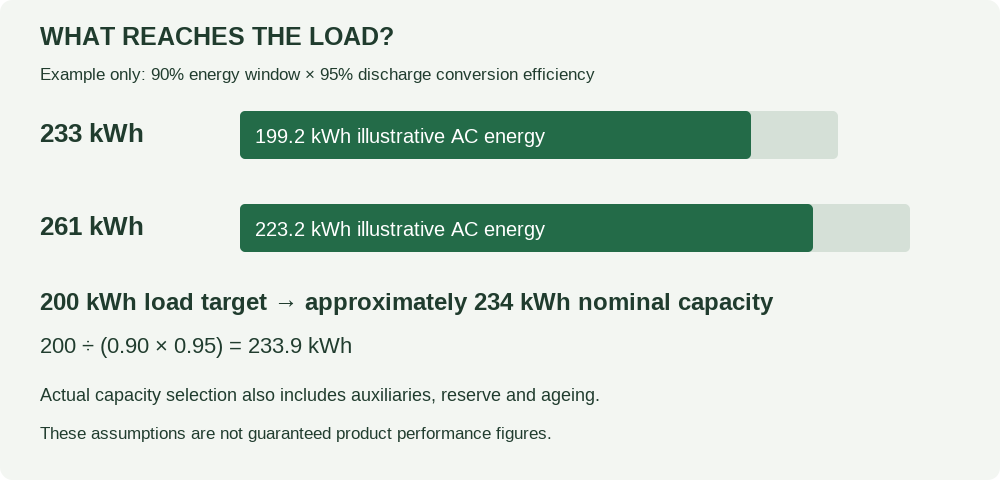 Open full-size diagram ↗
Under those assumptions, 233 kWh provides about 199.2 kWh at the load, just below the example target. The 261 kWh option provides about 223.2 kWh, leaving some initial headroom. A final design still needs the actual system data and the required end-of-warranty performance.
| Decision | 233 kWh | 261 kWh |
|---|---|---|
| Daily energy need | Assess when the usable energy covers the duty with the required reserve. | Assess when the extra energy is regularly needed or additional headroom is justified. |
| Nominal capacity difference | Reference option. | 28 kWh more, approximately 12% above 233 kWh. |
| Converter power | Confirm quoted continuous AC kW. | Confirm quoted continuous AC kW; larger kWh does not establish a higher power rating. |
| Italian project documentation | CEI-certified option available from WAYTON. | CEI-certified option available from WAYTON. |
Certification availability is confirmed by WAYTON. Request the certificate matching the proposed model, converter and covered configuration; confirm the applicable standard, edition and any limitations stated in that document.
5. Existing solar or a new project? Choose the connection route.
AC-coupled storage
For an existing PV installation, assess a separate battery converter connected to the site AC bus. Review the existing inverter, metering and export controls before deciding which equipment can remain.
Hybrid PV + storage
For a new installation, compare an integrated hybrid architecture. Match PV input limits, battery compatibility, AC rating and operating modes to the proposed equipment.
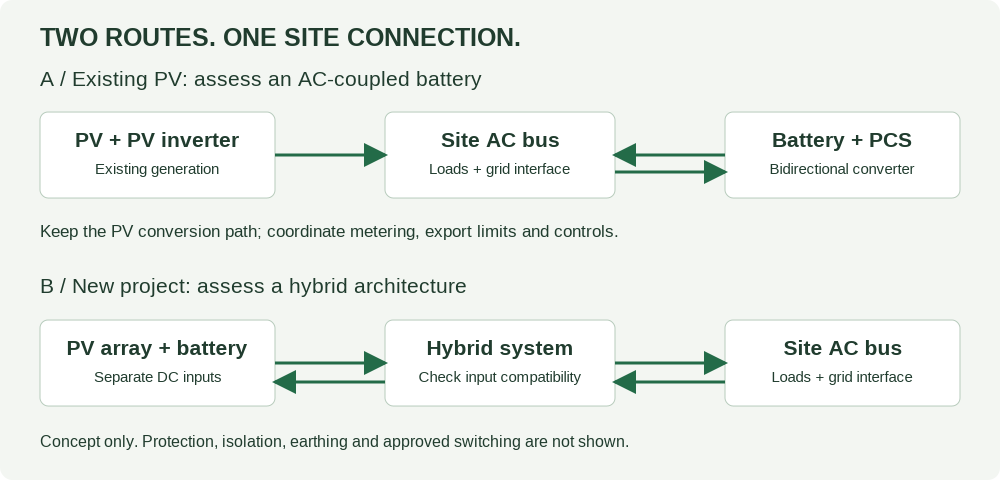 Open full-size diagram ↗
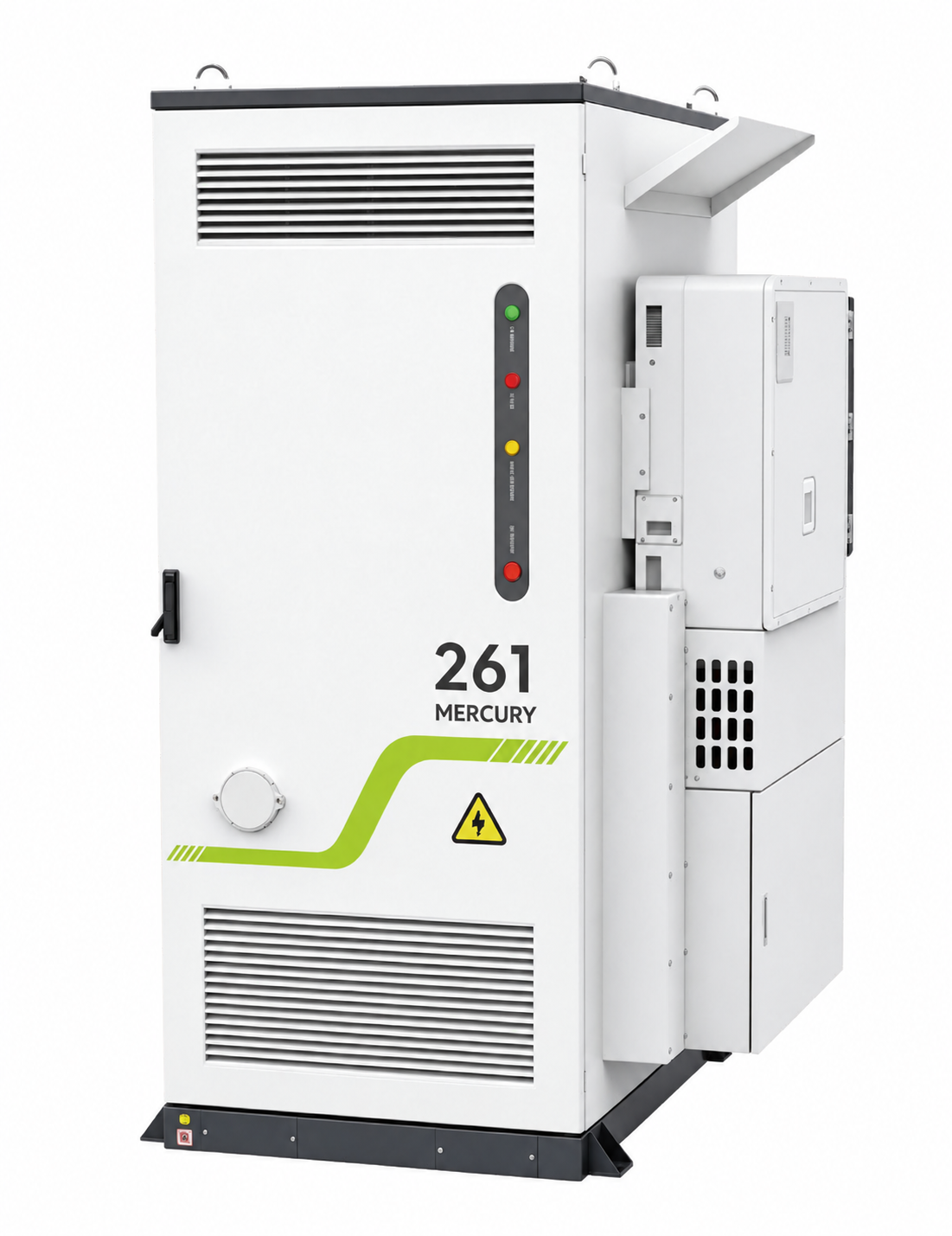
Mercury 261 Hybrid ESS
The supplier’s EU datasheet describes a liquid-cooled integrated system for small and medium C&I applications. Use its model-specific data to assess the hybrid route; do not transfer its ratings to every 261 kWh configuration.
View the hybrid product datasheet →6. How do CEI requirements affect the equipment choice?
Start with the project’s point of connection. CEI 0-21 addresses low-voltage connections; CEI 0-16 addresses medium- and high-voltage connections. Use the applicable edition and the DSO’s connection conditions. A battery on an internal LV bus does not turn an MV-connected facility into an LV-connected project. [1]
233 kWh / 261 kWh
Both capacity options are available with CEI certification. Match the supplied certificate to the exact proposed equipment configuration.
| Check | What the project team should establish |
|---|---|
| Equipment evidence | Applicable certificate and declaration, exact model and any converter or firmware limitations stated in the documentation. |
| Plant design | Single-line diagram, interface protection and disconnection, metering, earthing and control requirements. |
| Connection completion | Required tests, submissions and operating agreement for the local DSO. |
A product certificate is part of the technical evidence; it does not replace acceptance of the complete installation. E-Distribuzione publishes its connection guides and forms, while other DSOs apply their own connection conditions. [2]
For an MV site, also check transformer loading in both charging and discharge scenarios. Battery kWh does not determine transformer kVA. See our Italian transformer selection guide for the converter, voltage and transformer checks.
7. What else belongs in the specification?
Temperature & installation
Specify ambient temperature, sun exposure, corrosion conditions, access and noise constraints. Request continuous-power derating, cooling auxiliary consumption and service clearances for the actual cabinet.
Controls & backup
Define the EMS operating priority and measurement point. If outage support is needed, specify critical loads, islanding capability, transfer time and isolation arrangements from the start.
Grid-connected storage is not automatically a UPS. Confirm the actual transfer and overload capability against the loads. Reserving battery energy for outages reduces the energy available for everyday solar shifting.
Include fire detection and response provisions, site-specific safety design, communications, remote-access arrangements and commissioning responsibilities in the supply scope. Compare warranty throughput and capacity-retention conditions alongside years of coverage.
8. Compare an operating case, not a promised payback.
Build the comparison using the site’s actual import tariff, export value, expected operating days and installed cost. Include energy losses, auxiliaries, degradation, service and financing. Peak-related savings depend on the contract; do not count the same energy twice across different uses.
If 200 kWh of solar is diverted from export and the AC-to-AC round-trip efficiency is assumed to be 90%, 180 kWh is delivered later. At an assumed avoided import price of €0.25/kWh and foregone export value of €0.08/kWh, the gross daily energy value is 180 × €0.25 − 200 × €0.08 = €29.
Illustrative prices and efficiency only; not an Italian tariff forecast or a WAYTON savings guarantee. The €29 excludes auxiliary energy, degradation, operating costs, taxes and investment costs. Charging and discharging must both be feasible within the operating schedule.
9. Container-scale storage: qualify the complete project.
Large containerised BESS requires a case-by-case discussion. WAYTON offers product platforms with supporting conformity documentation; for a specific Italian order, the selected battery system, PCS, transformer, protection and controls must be assessed together against the project requirements.
Existing product qualification is the starting point. Once the order configuration and connection conditions are defined, agree the required project studies, integration checks, tests and any additional certification with the responsible parties. Final acceptance concerns the installed plant and its connection, not simply the container enclosure.
Existing qualification
Review product conformity declarations, applicable certificates and test reports, their validity and their coverage of the selected equipment and software versions.
Order-specific verification
Define the connection voltage, MW/MWh duty, PCS and plant controller, transformer and protection design, site conditions and the DSO or transmission-operator requirements.
- Confirm project and connection requirements
- Freeze the equipment configuration
- Agree studies, tests and certification scope
- Complete commissioning and connection acceptance
This distinction between qualified equipment and project acceptance is part of the connection process, not a WAYTON-only condition. It does not mean every order must repeat all product type tests. Additional evidence or testing depends on the chosen configuration, changes outside existing certificate coverage and the network operator's requirements. [2] [9]
Quick answers for project buyers
Is CE marking enough for an off-grid battery in Italy?
CE marking must be backed by conformity with all applicable product legislation and the required documentation. A genuinely isolated installation also needs the applicable electrical and fire-safety provisions. Zero-export grid-parallel operation is not off-grid.
Does a container BESS need new certification for every order?
The complete project needs a defined compliance and verification route. Existing certificates can support that assessment; additional tests or certification depend on the configuration and connection requirements. Repeating every product type test is not a blanket rule.
Does WAYTON offer CEI-certified storage for Italy?
WAYTON offers 233 kWh and 261 kWh options with CEI certification. Obtain the documentation for the proposed equipment configuration and match it to the project connection requirements.
Does a 261 kWh battery provide more power than a 233 kWh battery?
Not necessarily. kWh describes stored energy; continuous AC power is a separate kW rating. Compare both values in the actual quotation.
Can storage be added to existing rooftop PV?
An AC-coupled arrangement is a candidate for retrofit projects. Existing inverter compatibility, switchboard capacity, metering, protection and export controls must be reviewed.
Can a storage cabinet supply a business during a grid outage?
Only when the selected configuration and installation support the required backup operation. Specify critical loads, islanding, isolation and transfer requirements explicitly.
Turn the operating profile into an equipment brief.
Send WAYTON your interval consumption data, PV generation or proposed PV size, connection voltage and available single-line diagram. Add import/export limits, installation conditions and any backup requirement.
- Define the daily operating task
- Compare 233 / 261 kWh and AC power
- Match equipment evidence to the project
- Agree installation and service scope
WAYTON can help compare storage options and coordinate the proposed supply scope with your installer or engineering team.
Sources & technical scope
Technical references checked 20 October 2026. This guide addresses commercial and industrial selection. Capacity calculations and operating profiles are illustrative; final equipment and plant requirements follow the project design.
Technical references and product evidence
- [1] CEI · official CEI 0-16 and CEI 0-21 standards
Applicable editions, amendments and interpretation documents.
- [2] E-Distribuzione · grid connection rules
Connection guides, technical requirements and forms.
- [3] Mercury 261 Hybrid ESS · EU datasheet V2
Source of the hybrid product image and description. A product datasheet is not used here as evidence of CEI certification.
- [4] Mercury 261CE-UA · product datasheet
Source of the integrated-cabinet image only; the UA variant is not presented as the certified Italian configuration.
- WAYTON product availability confirmation · 20 October 2026
233 kWh and 261 kWh CEI certification availability supplied by WAYTON. Model-specific certificates should accompany the proposed supply.
- [5] SET Distribuzione · connecting energy storage
Distribution connection requirements and the application of CEI 0-16 / 0-21 to storage.
- [6] European Union · CE marking
Manufacturer responsibility, applicable legislation, declarations and technical documentation.
- [7] Regulation (EU) 2023/1542 · batteries
Applicable battery requirements, including stationary-storage safety. Check the provisions and application dates relevant to the product.
- [8] Vigili del Fuoco · fire-safety guidance
PV guidance referring to BESS fire-risk guidance DCPREV 21021 of 23 December 2024.
- [9] CEI · storage conformity and testing FAQs
Storage declarations and testing topics under the connection standards.